
Kansas City metro · John Beal Roofing since 1947
Fall Gutter Maintenance in Kansas City
A gutter is not decoration. It is the part of the system that decides where several thousand gallons of roof water ends up.
Why fall and not spring
Spring cleaning is fine, but it is the second most important pass. The material that actually plugs a Kansas City gutter comes off in October and November: maple and oak leaves, seed pods, and the twigs that break loose in fall wind. Clear it in April and it sits in there all winter first.
There is also a hard deadline on the fall pass, which is the first sustained freeze. Once the debris in a gutter is frozen into a block, you are not getting it out without either damaging the gutter or waiting for a thaw. And a frozen plug does the worst version of everything a clog does.
The timing does take some patience. Go up too early, while half the leaves are still on the tree, and you will be doing it twice. We generally tell people to wait until the trees over the roof are mostly bare, then get it done before Thanksgiving.
What a full gutter does to the house
It starts at the fascia. A clogged gutter holds an inch or two of standing water and wet debris directly against the fascia board it is screwed to. Wood stays damp, paint fails, and the board goes soft. Then the hangers lose their grip, the gutter sags, and the sag makes the drainage worse. It is a loop that accelerates.
Water that cannot get down the downspout goes over the front edge and lands in a line along the foundation. That is where basement seepage, settled walks and washed-out mulch beds come from. It is also the most fixable, because a downspout extension that carries water six or eight feet out is cheap.
Overflow at the back edge is worse and less visible. Water backs up under the drip edge, wets the bottom edge of the roof deck and the soffit, and follows the framing inside. When we pull rotten soffit and fascia off a Kansas City house, the cause is a gutter that has been overflowing behind itself for several seasons.
Pitch, hangers and seams: the part cleaning does not fix
A gutter run has to fall toward its outlet. Not much fall, but some, consistently. When a run is dead level or has settled into a low spot in the middle, it holds water permanently and grows the sludge that starts the whole cycle over. Standing water in a clean gutter means the pitch is wrong.
Hangers carry the load, and spacing is what determines whether a run holds its line under the weight of water, debris and ice. Old spike-and-ferrule installations work loose over time as the fascia takes freeze-thaw movement; hidden hangers screwed into solid wood hold far better. If a section is pulling away or has a wave in it, the hangers are the reason, not the cleaning.
Seams and end caps are the other leak source. Sectional gutter leaks at the joints eventually, which is the case for seamless runs formed to the length of the house. Inside and outside corners are still seams, though, and those get resealed. Downspouts matter too: a two-by-three downspout on a large steep roof plugs at the elbow constantly, and stepping up to a three-by-four moves a lot more water.
What the sludge in the bottom tells you about the roof
Every gutter has some grit in it and that is normal. What we are looking for is how much. A heavy layer of coarse granules, enough to feel like wet sand in the bottom of the trough, means the shingles above are shedding their surface.
Those granules are the shingle's sunscreen. When they are gone the asphalt underneath oxidizes fast, and that is a roof running out of life rather than a roof with a problem you can patch. If we find that while cleaning, we will say so and show you photos from the slope, not just from the gutter.
It is also a clue about hail. Granule loss concentrated below one slope, especially a slope that took a storm in the last couple of years, reads differently than even wear across the whole house. That is worth a proper look from the roof, and the inspection for it is free.
Doing it yourself, and when to call
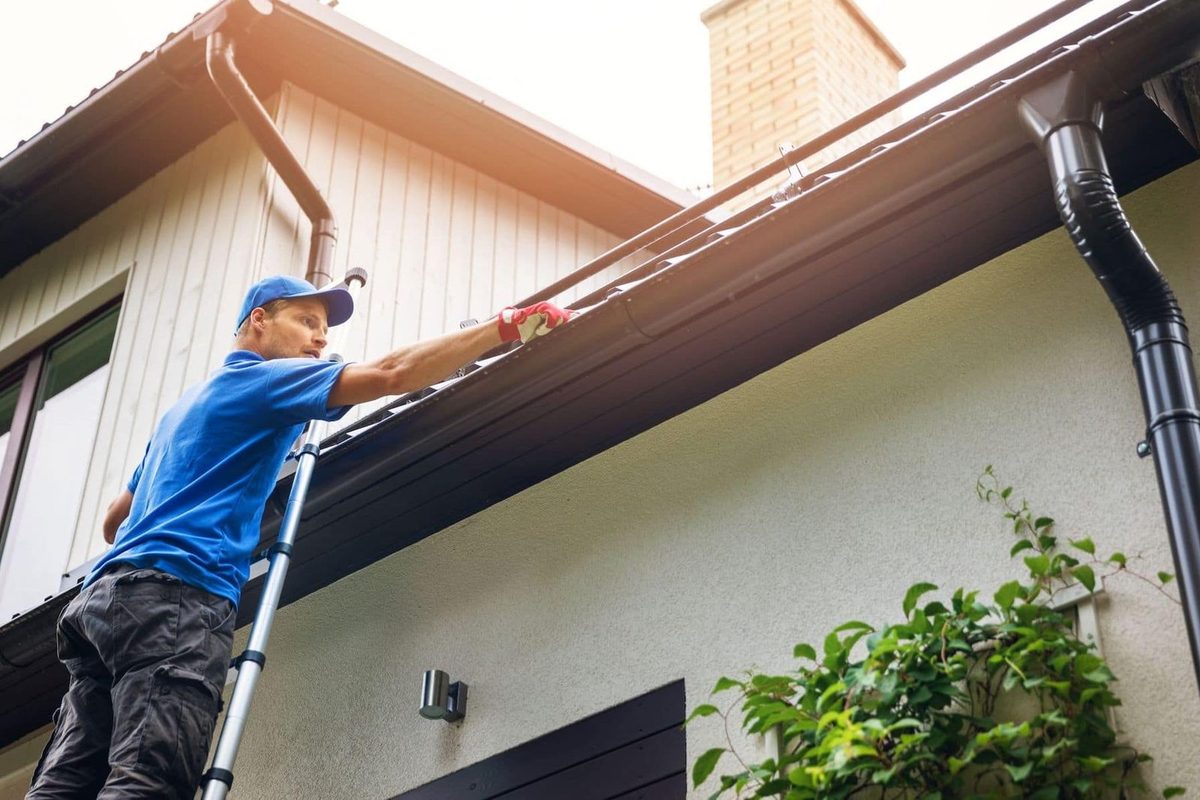
On a single-story house with safe ladder footing, this is a reasonable homeowner job. Stabilize the ladder, do not lean out past your belt buckle, scoop the debris into a bucket rather than onto the lawn, then flush each run with a hose and watch where the water actually goes. That last step is the one people skip, and it is the one that finds the plugged elbow.
Stay off the roof to do it, and skip the pressure washer. High pressure drives water back under the drip edge and it will strip granules off the shingles at the eave.
Call us when the house is two stories, when the roof is steep, when a run is sagging or pulling away from the fascia, when the fascia or soffit is soft, or when the water is coming out anywhere other than the bottom of the downspout. We can also handle it as part of a free roof inspection, so it is one trip instead of two.
Frequently asked
How often do Kansas City gutters need cleaning?
Are gutter guards worth putting on?
Can clogged gutters really cause ice dams?
Do you repair gutters or only clean them?
Should downspouts drain into underground pipe?
Related Kansas City roofing pages
Gutter Check in Kansas City
Free, no obligation, and we hand you the photographs either way.
Get the gutters cleared and checked before the first hard freeze
We look at pitch, hangers, seams and downspout drainage while we are up there, and you get photographs of whatever we find.