
Kansas City metro · John Beal Roofing since 1947
Signs You Need a New Roof in Kansas City
Most of what tells you a roof is finished can be checked from the ground, the gutter and the attic. No ladder required.
What you can see from the ground
Stand across the street with the sun behind you and look along the plane of each slope rather than straight at it. A healthy roof reads flat and even. A finished one reads textured, with corners lifting and courses no longer lining up.
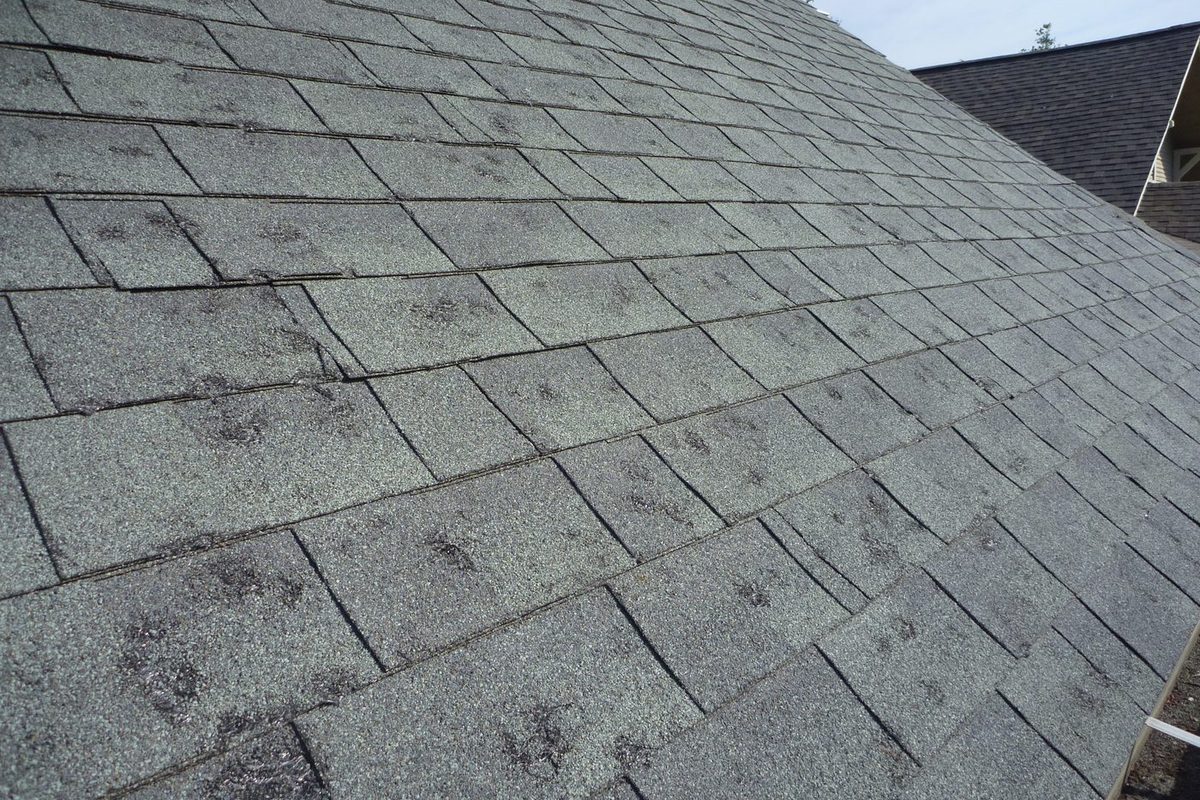
Cupping is the clearest single sign. The shingle edges curl upward as the mat dries out and shrinks, and once a slope is cupping it is not coming back. Cracking runs with it: hairline splits across the tab rather than along a seam. Bald patches where the granule layer is gone expose black asphalt, and asphalt without granules on it is being destroyed by sunlight directly.
Then look at the lines. A ridge that dips in the middle, a slope with a visible wave in it, or a sag around a chimney is a decking or framing issue, and that moves the conversation past shingles entirely. Do not sit on that one.
What the gutters and downspouts tell you
Granules are the roof's sunscreen, and they leave in a predictable order. A brand new roof sheds loose granules for the first few weeks, which is normal and stops. A roof in the last few years of its life sheds continuously.
The easiest place to check is the bottom of a downspout. Put your hand under the outlet after a heavy rain. If you come away with a palm of coarse black sand, and you get the same result at more than one downspout, the field is wearing out across the whole roof rather than at one spot.
While you are down there, look at the gutter itself. Dents across the top edge and the aluminum hood over the downspout mean hail landed hard enough to damage soft metal, and if it damaged the gutter it very likely bruised the shingles. That is worth documenting before you do anything else.
Go into the attic on a bright day
Pick a sunny afternoon, take a flashlight, and turn the light off once you are up there. Daylight coming through the sheathing at anything other than a vent is water's way in too.
Then look at the underside of the decking with the flashlight. You want uniform, dry wood. Dark blotching around nails, rippled plywood, or a white crusty bloom on the sheathing all mean moisture is getting into that space, either from a leak or from a ventilation problem the roof is not solving.
Check where the insulation meets the eaves while you are there. If it is packed tight into the soffit bays, the intake air the roof needs is not getting in, and that alone has taken years off more Kansas City roofs than hail has. Sniff the air. Persistent musty smell in an attic is a moisture problem even with no visible stain.
Inside the house, watch the edges of rooms
Ceiling stains do not appear where the hole is. Water lands on the decking, runs down the underside, travels along a rafter, and drops wherever gravity finally wins, which can be fifteen feet from the entry point and on the other side of a wall.
So look at the outside corners of upstairs rooms, the ceiling line where a second story meets a lower roof, and the wall directly below a chimney. A faint tea-colored ring that gets slightly larger after each hard, wind-driven rain is an active leak, not an old one.
Interior paint bubbling on a wall under a roofline, a bedroom door that suddenly sticks in its frame, or nail heads showing through drywall on an upper ceiling are all the same story told differently: something above is holding moisture.
The signs that mean call today
Any of these should not wait for a convenient week. A dip or wave in the roof plane. Water actively running during rain. Missing shingles across a section after a storm, especially along the rake or the first few courses at the eave, which is where wind gets started.
Also urgent: exposed decking anywhere, a chimney with counterflashing pulled loose, or a section of roof where the underlayment is visible. Those are all open holes with a delay on them, and the delay ends with the next system that comes through.
Everything else on this page can be looked at on a normal schedule. We do not charge for the visit, we do not use door-knockers, and when a roof is fine we say so in writing. A free inspection on a typical house runs about forty minutes and you keep every photograph we take.
Frequently asked
Granules in the downspout: how much is actually normal?
My shingle corners are curling but nothing leaks. Is that still a problem?
Is a sagging ridge line always structural?
There is a musty smell upstairs with no visible stain. Where do we look?
Should I get up on the roof myself to check?
Related Kansas City roofing pages
- Free Roof Inspection in Kansas City
- Roof Replacement in Kansas City
- Roof Leak Repair in Kansas City
- Attic and Roof Ventilation in Kansas City
Areas we cover for this work
Signs You Need a New Roof
Free, no obligation, and we hand you the photographs either way.
Get a written roof replacement scope, not a number on a napkin
Free inspection, photographs you keep, and a line-by-line scope you can compare against any other bid in your stack.