
Kansas City metro · answered live 24/7
Wind Damage Roof Repair in Kansas City
Missing shingles are the easy part. The damage that costs you later is the shingle still sitting there with a broken seal underneath it.
How wind actually gets a shingle off
Every asphalt shingle has a strip of factory adhesive on it. Sun heat softens that strip after installation and it bonds each shingle to the course below, so the roof behaves like one continuous surface instead of a stack of loose tabs. That bond is the whole wind rating. Break it and the rating is gone.
Wind does not push a shingle down. It runs up the slope, hits an edge, and lifts. Once air gets under the bottom edge of a tab, the pressure works on the seal strip like a pry bar, in the same spot, thousands of times in a few minutes. Some tabs let go and fly. Plenty more break the seal and lay back down.
That second group is the reason we do not just patch the bare spot and leave. A roof that lost six shingles on the southwest slope usually has three or four times that many unsealed, and those will come off in the next event with a lot less wind than it took the first time.
Creased shingles are damage even though nothing is missing
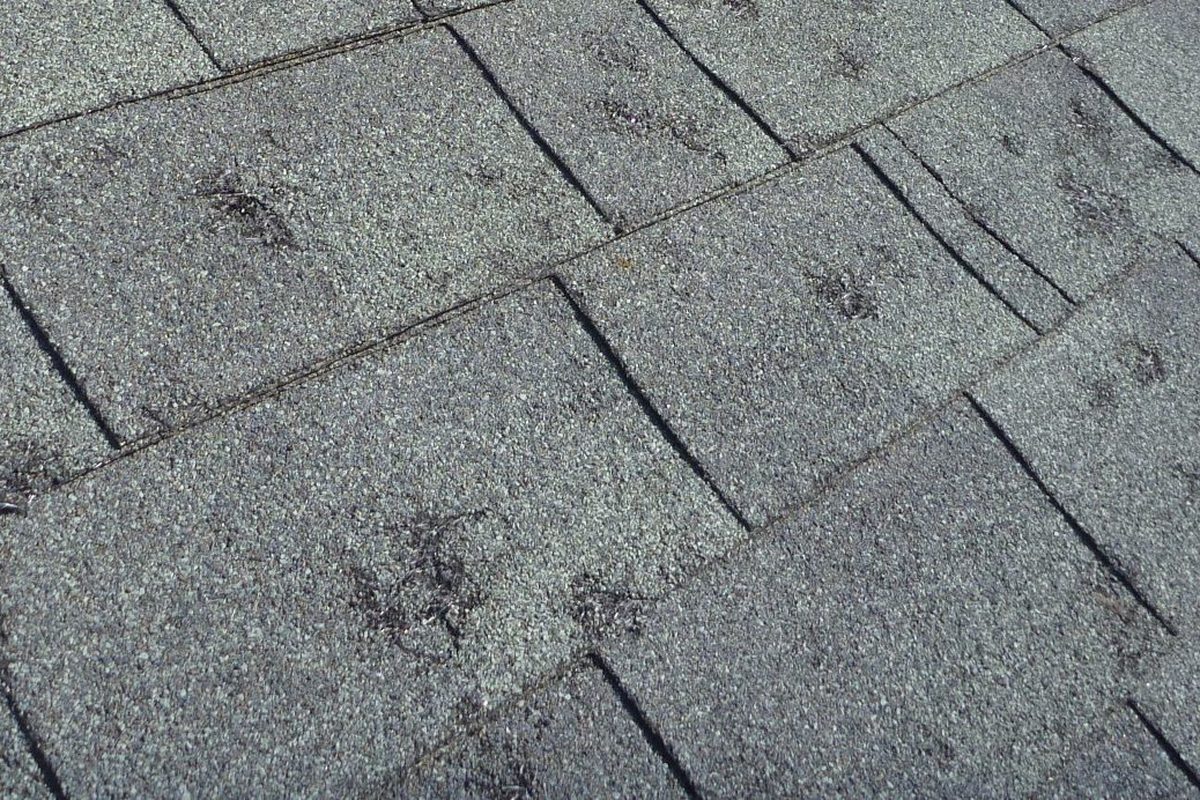
When a tab folds back and slaps down, the mat inside it cracks along the fold. You can see the line on the surface, a straight crease running across the tab, sometimes with the granules scuffed off it. Water follows that crack straight to the underlayment.
Creasing is the item homeowners argue about most, and it is also the item that gets missed when nobody walks the roof. From the ground a creased shingle reads as a normal shingle. We chalk them, photograph each one with the slope noted, and lift tabs by hand across the field to find out how far the unsealing goes.
We will also tell you when the answer is a repair. If a house lost four tabs on one slope and the rest of the field is still bonded tight, we say so, price the repair, and go home. A wind event is not automatically a new roof.
The parts of a roof wind reaches first
Rake edges take it worst, because that is the leading edge on most Kansas City houses and there is nothing above it to break the flow. Hips and ridges are next. Ridge cap is a single layer of folded shingle carrying the highest pressure on the roof, and it is very often the only damage on the whole house.
The first two or three courses above the eave come off more than people expect, especially where a starter strip was skipped at install or a drip edge was left short. Wind gets under the overhang, into the soffit, and pushes up from inside the attic at the same time it pulls from outside.
Off the roof itself, we look at gutter hangers pulled loose, fascia lifted at the corners, siding at gable peaks, and any vent hood or turbine that has shifted on its base. A vent that has been rocked out of position leaks in the first rain and gets overlooked because everyone is looking at the shingles.
What happens when you call us after a wind event
First we cover anything open. If a slope is bare or decking is showing, that gets a tarp fastened down properly, not weighted with bricks. We do that at night, and the phone is answered live around the clock, which matters when the wind comes through at nine in the evening.
Then the actual inspection, in daylight, on the roof. Every slope, tabs lifted by hand in a pattern rather than one spot, seal condition noted, creases chalked and photographed, penetrations and flashings checked, soft metals and the ground-level items looked at. You get the photographs whether or not you ever hire us.
After that you get a written scope. It says what is being replaced, what is being reused, the per-sheet price if we find bad decking, who pulls the permit, and how cleanup runs. You can hand that document to another roofer and compare it line for line, and we would rather you did that than take our word for it.
How wind damage reads on an insurance claim
Carriers treat wind as its own peril, separate from hail, and they generally want to see a date, a direction and a pattern that matches. That is why we note which slopes the damage sits on and photograph the debris field before it gets cleaned up. A pile of tabs in the neighbor's yard northeast of the house is evidence.
Our part is documentation. We meet the adjuster, walk the roof with them, and show what we found. We do not negotiate claims and we do not act as your representative with the carrier, and any contractor who offers to do either is telling you something about how they operate. We also cannot absorb your deductible, and we will not offer to.
If you want to understand the paperwork before the adjuster shows up, the Missouri and Kansas claim walkthroughs cover the sequence, and there is a separate page on why the first check is smaller than the estimate.
Frequently asked
How much wind does it take to lift shingles?
Only a few shingles blew off. Do I need a whole new roof?
Can you match shingles on a ten-year-old roof?
Do you tarp at night?
Is wind handled differently than hail on a claim?
Related Kansas City roofing pages
Wind Damage Roof Inspection in Kansas City
Tell us when the wind came through and what you found in the yard. We will get out and look.
Lost shingles last night? We answer the phone at 2 a.m.
Same-day cover on an open roof, a full slope-by-slope inspection after, and photographs you keep either way.