
Kansas City metro · John Beal Roofing since 1947
Winter Roof Problems in Kansas City
Cold does not wear a roof out the way sun does. It finds whatever was already marginal and opens it up in a week.
Cold makes a shingle brittle
An asphalt shingle is flexible when it is warm and stiff when it is not. Below about forty degrees it stops bending and starts breaking, which changes what can safely be done on a roof. Walking a cold roof cracks shingles under your boots. Bending a tab back to slide a new one under it can snap it clean off.
That is the real reason a good crew slows down in January rather than an unwillingness to work in the cold. The nailing has to be right, the shingle has to be handled carefully, and the self-sealing adhesive strip that bonds each course to the one below it will not activate until the sun warms it up.
On a cold-weather repair or replacement, those strips get hand-sealed with roofing cement so the roof is not depending on spring sunshine to become wind-resistant. It is extra labor and it is not optional. A winter roof installed without hand-sealing is a roof waiting for the first forty-mile-an-hour day in March.
Freeze-thaw finds every seam
Kansas City does not stay frozen. We swing across the freezing mark repeatedly all winter, and every swing moves water into a crack, expands it, and leaves the crack slightly wider than it was. Do that thirty times and a hairline gap in old sealant is an opening.
The places it shows up are consistent. Counterflashing at masonry chimneys, where mortar joints are already weathered. Step flashing along a sidewall, particularly where a previous repair used caulk instead of metal. Around skylight frames. At the collar of a plumbing vent. Exposed nail heads on a ridge or a hip that were dabbed with sealant years ago and are now bare.
Chimneys deserve their own mention because two different materials are failing at once: the mortar and the flashing that has to be cut into it. If the joints are crumbling there is nothing sound to anchor to, so the masonry has to be addressed before flashing will hold. We would rather say that up front than come back twice.
Frost in the attic is not a roof leak
A call we get several times each winter: water dripping from the ceiling or staining in a closet with no rain in the forecast. The homeowner is sure the roof is leaking. When we get in the attic, the underside of the deck is covered in frost, or it is thawing and running down the rafters.
That water came from inside the house. Showers, cooking, laundry, and just breathing put moisture into the air, and warm air holds more of it. That air leaks up through gaps in the ceiling plane, hits a deck that is twenty degrees, and the moisture condenses and freezes. The first mild day it melts all at once and looks exactly like a roof leak.
The fix is air sealing and ventilation, not shingles. Seal the ceiling penetrations, make sure bath fans and the dryer terminate outside the building envelope rather than into the attic, and get intake and exhaust balanced so the attic stays close to outside temperature. We check for this before we ever quote a repair, because replacing a perfectly good roof will not dry that attic out.
Winter wind behaves differently than summer wind
Summer wind works on a roof whose sealant strips are soft and tacky. Winter wind works on a roof whose strips are hard. A shingle that would flex and stay down in July can lever up and crease in January, and a creased shingle does not lie back down. The crease is a permanent hinge that lets water under it.
Look at the edges after a windy stretch. Rakes, eaves, ridge caps, and the first few courses above a roof-to-wall transition. Those are the pressure zones. Dark patches scattered across a slope usually mean granule loss or lifted tabs, and pieces of shingle in the yard mean somebody's roof lost material, which is worth confirming is not yours.
Gutters take winter wind and ice load together. A gutter full of frozen debris can weigh a few hundred pounds per run, and that weight pulls hangers out of fascia that may already be soft from a summer of overflow. When the gutter goes, it usually takes a strip of fascia board with it.
What we can and cannot fix in the cold
We will do emergency work any hour, any temperature. Tarping a hole, stopping an active leak, steaming out an ice dam, replacing a cracked pipe boot, rebuilding a section of step flashing. Those are all legitimate winter jobs and waiting on them costs you interior damage.
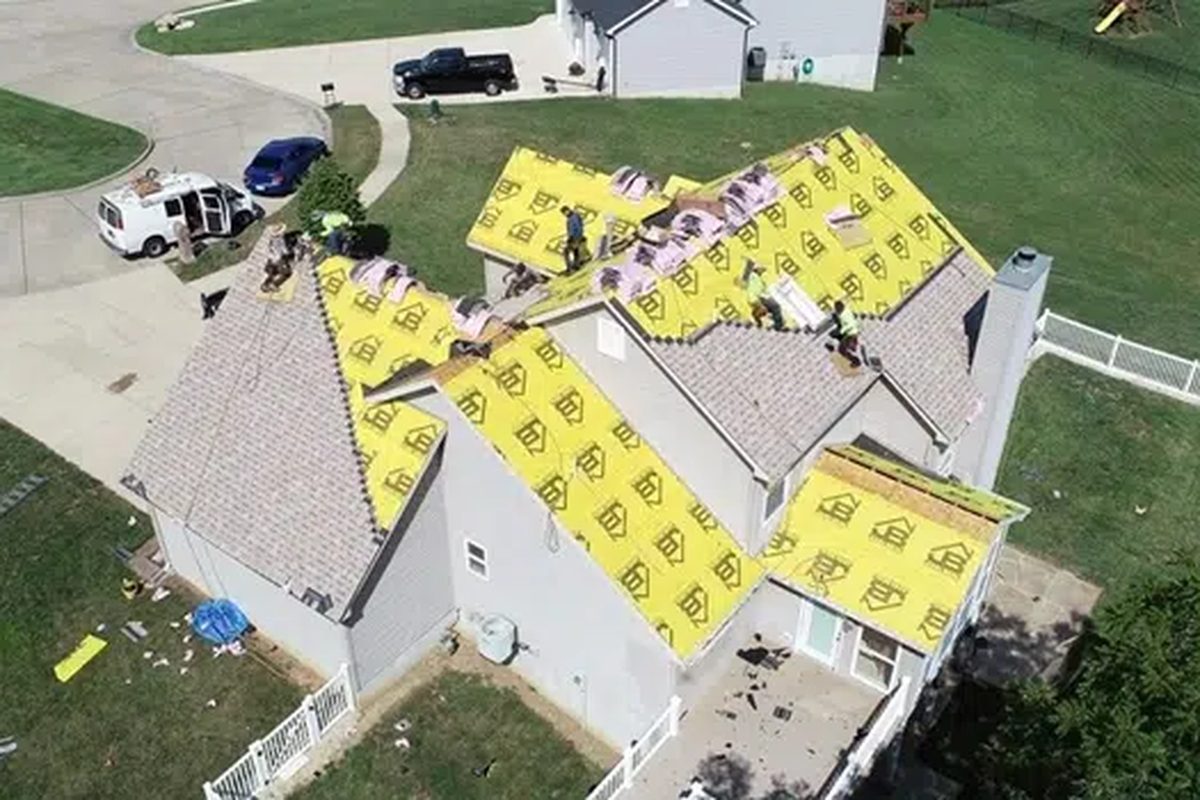
Full tear-offs in deep cold are a judgment call, and it depends on the day rather than the month. Dry conditions in the upper thirties with sun on the slope is workable with hand-sealing. Twenty degrees with wind and snow on the deck is not, and anyone who tells you otherwise is prioritizing their schedule over your roof.
So we will sometimes stabilize a roof in January and put the replacement on the calendar for a break in the weather. You get the repair in writing, the photos, and a straight answer about what the temporary fix buys you. Telling a homeowner to wait six weeks is not a sales strategy, which is exactly why you can trust it when we say the opposite.
Frequently asked
Can a roof be replaced in the winter in Kansas City?
Why is my ceiling wet when it has not rained?
Is it safe to walk on my roof in the cold to look at it?
How fast can you get out for a winter leak?
Does snow on the roof need to be removed?
Related Kansas City roofing pages
Winter Roof Repair in Kansas City
Free, no obligation, and we hand you the photographs either way.
A winter leak does not have to wait for spring
We answer the phone at two in the morning in January. Free inspection, photographs you keep, and an honest read on what can be repaired now versus what should wait for warm weather.