
Kansas City metro · John Beal Roofing since 1947
How to Tell If Your Kansas City Roof Has Hail Damage
You cannot see most hail damage from the driveway. Here is what you can check, and what needs someone on the roof.
Short answer
You generally cannot confirm hail damage from the ground, but you can find strong indicators: dents in gutters, downspouts and roof vents; granules collecting in gutters and at downspout outlets; dings on the air conditioner fins; chips in window screens, deck boards or fence tops; and dents in any painted metal on the property. Hail damage to the shingles themselves is a fracture of the mat under the granules, which requires someone on the roof to confirm.
Check the soft metals first
Aluminum and thin painted metal record hail impacts far more visibly than shingles do, and they are at eye level. Walk the perimeter and look at the gutters, particularly the top surface of the front lip. Look at downspouts. Look at the metal roof vents and any flashing you can see.
Then look at the air conditioner condenser. The fins are thin aluminum and they dent with very little force. A condenser with fresh dimpling on the exposed side is one of the most reliable ground-level indicators there is, and it is also itself claimable damage that homeowners routinely forget to include.
Window screens, mailboxes, gutter aprons, deck rails and fence caps all record impacts too. What you are building is a picture of whether hail of a damaging size actually fell at your address, which is a different question from whether it fell in your ZIP code.
Look for granules
Granules are the crushed mineral surface that protects the asphalt from UV. Hail knocks them loose. After a damaging storm they wash into the gutters and out the downspouts, and you will see them collecting at the downspout outlet like coarse black sand.
Some granule loss is normal, particularly on a new roof shedding loose surface material. A sudden accumulation right after a hailstorm is not normal, and it is worth photographing.
What has to happen on the roof
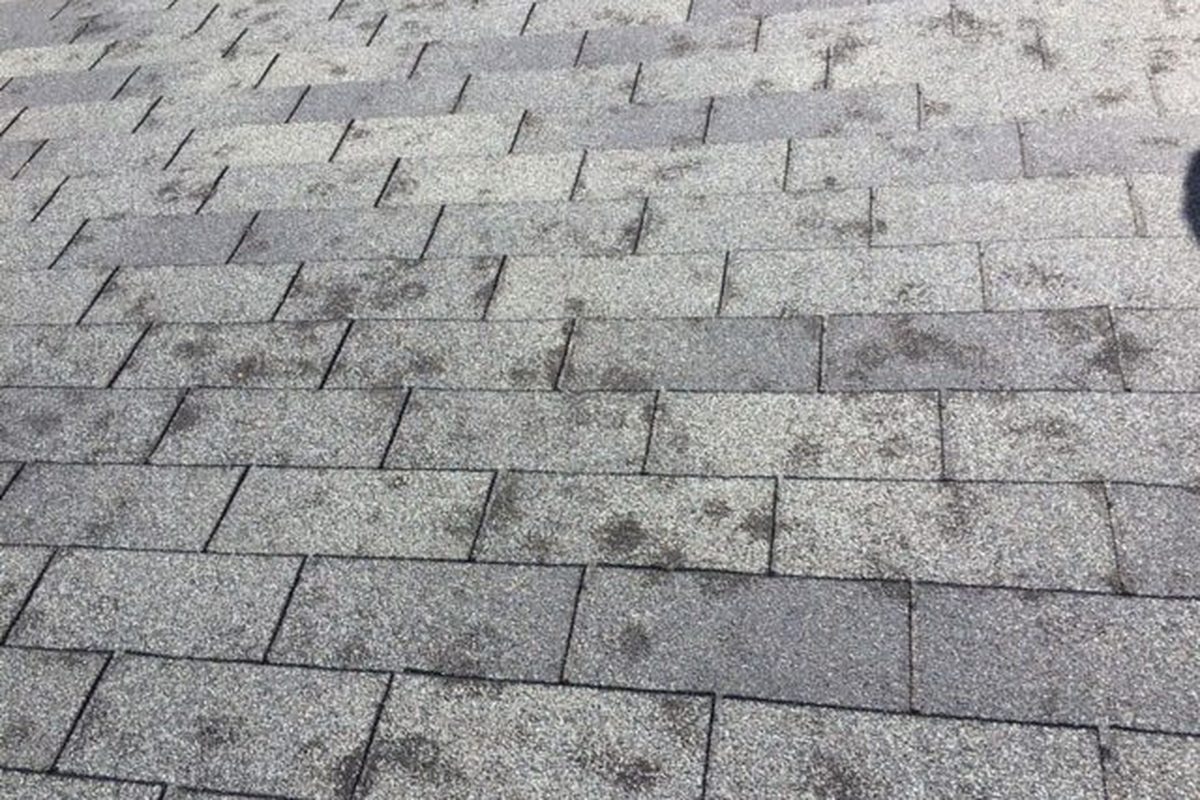
Confirming hail damage means someone examining each slope individually, because hail is directional. The inspector chalks impacts, counts them per test square, and photographs with a scale reference. A hit shows as a dark bruise where granules are displaced, and it feels soft under a thumb because the mat beneath has fractured.
That count per square is what the adjuster works from. Different carriers use slightly different thresholds, but the principle is the same: enough functional damage across a slope means the slope is compensable.
This is not something to do yourself. Roofs are dangerous, and walking a hail-damaged roof incorrectly can create marks that muddy the assessment.
What to do in the days after a storm
Photograph everything, including the ground-level indicators and any hail you can still see. Note the date and time of the storm. Do not let anyone who knocked on your door get on your roof before you have decided who you are working with.
Get a real inspection from a company with a local address and a history. Then, if there is damage, file with your carrier. Do not file first and inspect later, because a claim filed on a roof with no damage is still a claim on your record.
Frequently asked
How big does hail have to be to damage a roof?
My neighbor got a new roof and I was told mine is fine. Is that possible?
Does hail damage always leak?
Should I let a door knocker inspect my roof?
How soon should I get inspected after a storm?
More Kansas City roofing resources
How to Tell If Your Kansas City Roof Has Hail Damage
Free, no obligation, and we hand you the photographs either way.
Get your roof checked after the storm
Free inspection of every slope and every structure, documented for your carrier.