
Kansas City metro · John Beal Roofing since 1947
Roof Underlayment and Ice-and-Water Shield in Kansas City
The layers under the shingles are what stop water when the shingles don't. Here's what goes where, and why it matters on a Kansas City house.
Two layers with two different jobs
Shingles aren't a sealed surface. They overlap, and they're held down by nails driven straight through them into the deck. Wind can push rain sideways under a tab. Ice can hold meltwater on the roof long enough for it to creep uphill. When either of those happens, the layer underneath is the next thing the water reaches.
Underlayment covers the whole deck. It sheds water that gets past the shingles, and it keeps the plywood dry during the install, in the hours before the shingles are on. It isn't built to hold back water that sits on it.
Ice-and-water shield is. It's rubberized asphalt with a sticky back that bonds to the deck, and when a nail goes through it, the membrane closes tight around the shank. That self-sealing property is the reason it gets placed in the spots where water collects or moves slowly.
Synthetic underlayment or felt
For decades the standard was asphalt-saturated felt, sold as 15-pound or 30-pound. Felt works. It also tears under boots, wrinkles once it gets wet, and can't sit out in the weather for long. A wrinkled sheet shows through the finished shingles as a ripple you can see from the street.
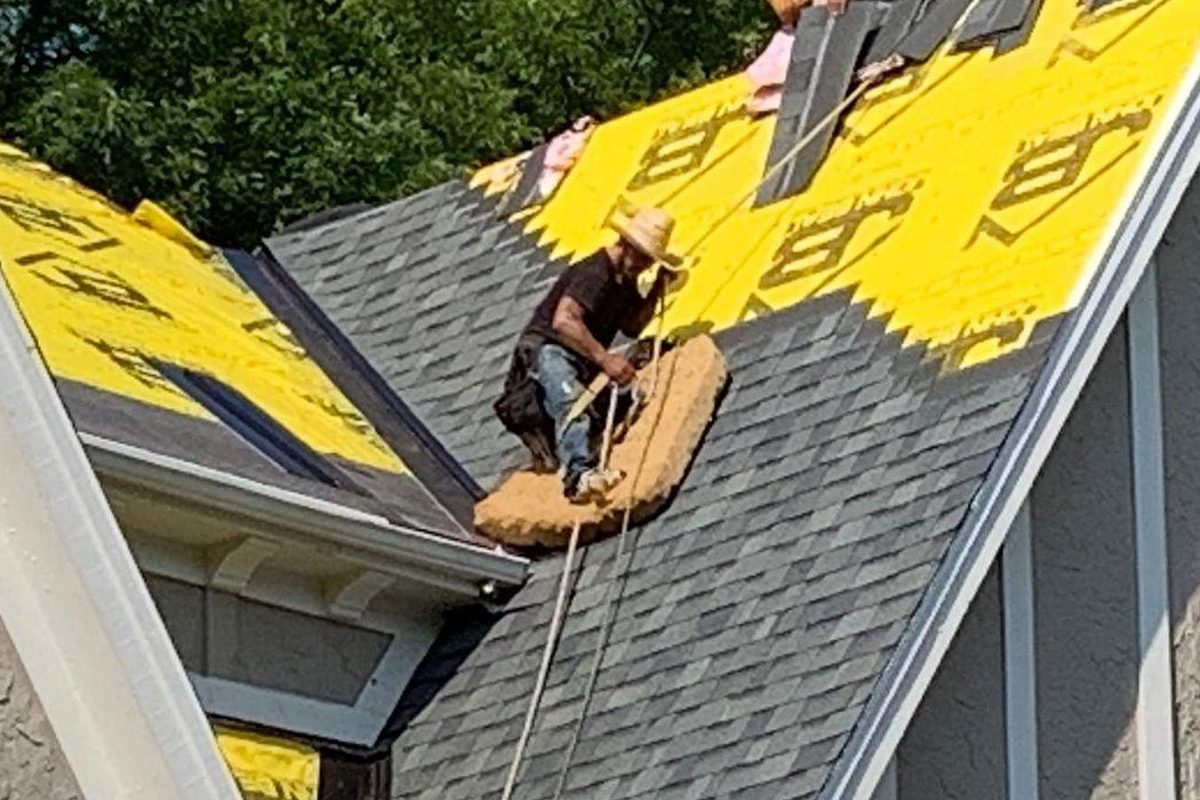
Synthetic underlayment is a woven or spun polymer sheet. It's lighter, hard to tear, lies flat, and gives the crew better footing on a steep pitch. The major shingle manufacturers each make a synthetic meant to go with their shingles, and using the matching product is often part of qualifying a roof for a system warranty. The yellow sheet in the photo at the top of this page is synthetic underlayment going down ahead of the shingles.
Felt still shows up on some low bids, and it isn't a code violation. You should still know which one you're buying. The bid ought to say.
Where the membrane goes on a KC roof
Eaves. The bottom edge of the roof, over the gutters, is where ice dams form. Attic heat melts snow higher up, the water runs down, and it refreezes at the cold overhang. Water trapped behind that ridge of ice has nowhere to go except up under the shingles. Where code calls for an ice barrier, it runs from the edge to at least 24 inches inside the exterior wall line. On a house with deep overhangs, that takes two courses of membrane.
Valleys. Two roof planes empty into one channel. A full-width strip down the center of every valley goes in before the valley metal or the shingles.
Walls, chimneys and skylights. Wherever the roof meets something vertical, the membrane is turned up the wall behind the flashing. Flashing does the main work there. The membrane is the backup if a joint opens up years later.
Shallow sections. Shingles aren't allowed below a 2/12 pitch. Between 2/12 and 4/12, code requires two layers of underlayment or a full membrane under them, so a porch roof or a shallow tie-in between gables often gets membrane wall to wall.
Why not cover the whole deck in membrane?
It's a fair question, and on some roofs full coverage is the right call. The tradeoff is that the membrane is a vapor barrier. Spread across an entire deck on a house that's short on ventilation, it can trap moisture rising from the attic, and the plywood takes the damage. It costs more, too, and it bonds to the deck so firmly that the next tear-off often means replacing sheets that would otherwise have been fine.
On a typical Kansas City house with balanced intake and exhaust, we put membrane where water concentrates and synthetic across the field. If an attic already has a moisture problem, we'd rather correct the ventilation than seal the moisture in.
What tear-offs show us
Old roofs tell you what got skipped. On tear-offs around the metro we find felt that has dried out and crumbled to flakes, valleys with nothing under the shingles, and eaves where the only protection was the shingle itself. A soft strip of decking along the bottom three feet of the roof is the usual result of that last one. Our roof decking page explains how soft sheets are found and replaced at a per-sheet price stated up front.
None of this is visible on a finished roof. That's the reason it belongs on paper.
Reading the underlayment line on a bid
A complete scope names the underlayment product, says the eaves get ice-and-water shield and how far up the roof it runs, lists the valleys and every wall, chimney and skylight that get membrane, and spells out how any shallow sections are covered. If all a bid says is "underlayment," ask what kind and where the membrane goes.
Our drip edge and starter course page covers how these layers stack at the roof edge, and the ice dam page explains the winter problem the eave membrane is there to handle. All of it is standard on a roof replacement with us.
Underlayment work around the metro
Every replacement we do includes new underlayment and ice barrier, on both sides of the state line. A few of the communities we work in:
Frequently asked
Is ice-and-water shield required in Kansas City?
Is synthetic underlayment better than felt?
Can underlayment be replaced without new shingles?
How long can underlayment be left uncovered?
Does ice-and-water shield stop ice dams?
Related roofing services
Find out what's under your roof
Free inspection, a written scope that names every layer, and photos you keep.
Know what goes under your shingles before you sign
We list the underlayment, every membrane location and the flashing in writing, so you can compare bids on the parts you'll never see again.